

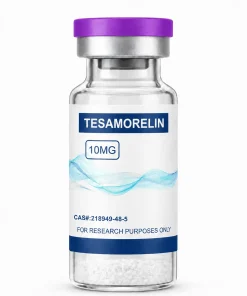

Tesamorelin 10mg
Tesamorelin 10mg is a synthetic growth hormone-releasing hormone (GHRH) analogue supplied as a research peptide for laboratory and preclinical research. Tesamorelin 10mg is structurally based on the 44-residue human GHRH(1-44) sequence and incorporates an N-terminal trans-3-hexenoyl modification together with a C-terminal amide. This molecular design distinguishes Tesamorelin from native GHRH and makes it an important research material for investigating GHRH receptor signalling and growth-hormone-axis biology.
Tesamorelin 10mg is commonly classified as a growth-hormone-releasing hormone analogue or GHRH analogue. Research on Tesamorelin focuses on its interaction with the GHRH/GRF receptor and the downstream biology associated with growth hormone signalling. Official product information describes tesamorelin as binding to and stimulating human GRF receptors, providing a useful mechanistic basis for laboratory studies of the GHRH–GH–IGF-1 axis.
Tesamorelin 10mg has a reported molecular formula of C₂₂₁H₃₆₆N₇₂O₆₇S and an average molecular mass of approximately 5,135.9 Da. The peptide contains 44 amino-acid residues, with the N-terminal trans-3-hexenoyl modification and C-terminal amidation forming important parts of its molecular identity.
Tesamorelin 10mg is intended for laboratory research and analytical applications rather than human or veterinary use. Researchers can use appropriate analytical documentation, including batch-specific HPLC and mass-spectrometry data where available, to evaluate product identity and purity.
What It Is
Tesamorelin 10mg is a synthetic peptide analogue of human growth hormone-releasing hormone (GHRH/GRF). It is also known by the development code TH9507 and is associated with CAS number 218949-48-5.
Tesamorelin 10mg contains a modified GHRH(1-44) peptide architecture:
- 44-residue GHRH analogue
- N-terminal trans-3-hexenoyl modification
- C-terminal amide
- Molecular formula: C₂₂₁H₃₆₆N₇₂O₆₇S
- Molecular mass: approximately 5,135.9 Da
- Research classification: GHRH analogue / growth-hormone-axis research peptide
- Typical research presentation: lyophilized peptide
The N-terminal modification is an important identity feature of Tesamorelin 10mg and should be considered when comparing analytical data against native GHRH.
Research Applications
Tesamorelin 10mg is used in laboratory research involving:
- GHRH receptor research — investigation of GHRH/GRF receptor activation and signalling.
- Growth hormone signalling research — study of pathways associated with endogenous growth hormone release.
- Endocrine research — investigation of the growth hormone regulatory axis.
- IGF-1 pathway research — examination of downstream endocrine signalling associated with GH activity.
- Peptide receptor pharmacology — research into synthetic peptide analogues interacting with GHRH receptors.
- Pituitary signalling research — investigation of GHRH-mediated signalling mechanisms.
- Metabolic research — laboratory investigation of growth-hormone-axis relationships with metabolic processes.
- Adipose biology research — investigation of growth-hormone-axis signalling in adipose-tissue research models.
These applications describe research areas rather than therapeutic claims for Tesamorelin 10mg. Official pharmacology information reports that tesamorelin stimulates growth hormone secretion and subsequently increases IGF-1 and IGFBP-3 in the clinical pharmacology context.
Quick Specs
| Specification | Tesamorelin 10mg |
|---|---|
| Product | Tesamorelin 10mg |
| Compound Class | GHRH analogue |
| Research Category | Growth Hormone / Endocrine Research |
| Development Code | TH9507 |
| CAS Number | 218949-48-5 |
| Molecular Formula | C₂₂₁H₃₆₆N₇₂O₆₇S |
| Molecular Weight | ~5,135.9 Da |
| Peptide Length | 44 residues |
| Structural Type | Modified GHRH(1-44) analogue |
| N-Terminal Modification | Trans-3-hexenoyl |
| C-Terminal Modification | Amide (-NH₂) |
| Form | Lyophilized research peptide |
| Quantity | 10mg |
| Intended Use | Laboratory research only |
The molecular identity information above is consistent with published compound records and analytical reference documentation.
Documentation, Handling and Comparison Notes
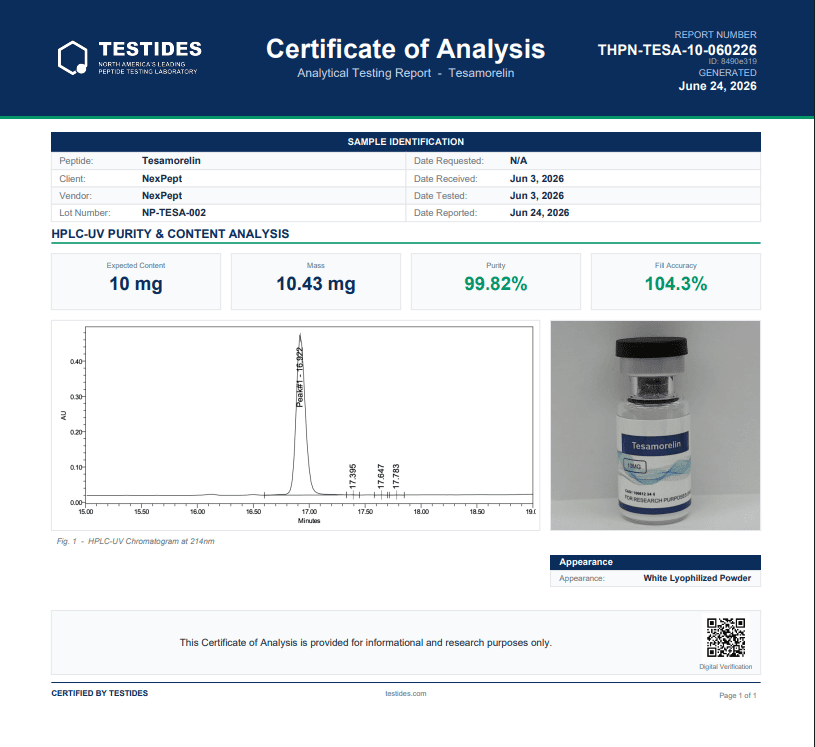
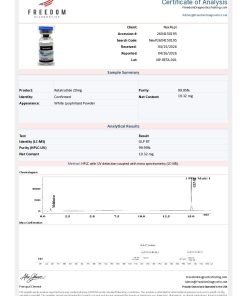
Tesamorelin 10mg should be supplied with appropriate batch documentation where available, such as a Certificate of Analysis (COA), HPLC purity information and identity/mass-spectrometry data.
For research comparison purposes, Tesamorelin 10mg should not be confused with other growth-hormone-related peptides such as sermorelin, GHRH, CJC-1295, or GH secretagogues such as ipamorelin. Tesamorelin is specifically characterized by its modified 44-residue GHRH analogue structure.
When evaluating Tesamorelin 10mg documentation, researchers should compare:
- Product name and catalogue identifier
- Batch/lot number
- Expected molecular mass
- HPLC purity
- LC-MS or equivalent identity data where provided
- Peptide sequence and structural modifications
- Physical appearance
- Manufacturer/supplier documentation
For storage and laboratory handling, researchers should follow the conditions stated on the current batch documentation and applicable laboratory protocols. Avoid relying on generic handling instructions where the manufacturer’s lot-specific documentation provides different requirements.
Important Research Notice
Tesamorelin 10mg is supplied by PeptivaSale as a research-use material. It is not being offered as a medicine, dietary supplement, cosmetic, food product or therapeutic treatment.
Tesamorelin 10mg is not intended for human consumption, self-administration, or veterinary use.
This product description is provided for laboratory research, analytical investigation and educational purposes. Nothing on this page should be interpreted as a recommendation to use Tesamorelin 10mg to diagnose, prevent, treat or cure any disease or medical condition.
Researchers are responsible for ensuring that their use, storage and handling of Tesamorelin 10mg comply with applicable institutional, regulatory and laboratory requirements.
Quality and Identification
Tesamorelin 10mg should be evaluated as a defined synthetic peptide using appropriate analytical methods.
Key identity characteristics include the 44-residue GHRH analogue backbone, N-terminal trans-3-hexenoyl modification, C-terminal amidation, molecular formula C₂₂₁H₃₆₆N₇₂O₆₇S, and molecular mass of approximately 5,135.9 Da.
For Tesamorelin 10mg, analytical quality assessment may include:
- HPLC purity analysis
- LC-MS or mass-spectrometric identity confirmation
- Batch-specific Certificate of Analysis
- Appearance assessment
- Lot and manufacturing records
A purity result alone does not establish molecular identity, so researchers should consider both chromatographic purity and identity data when evaluating Tesamorelin 10mg.
Current Research Focus
Tesamorelin 10mg is currently relevant to research involving the GHRH receptor, growth hormone signalling, endocrine regulation, IGF-1-associated pathways, peptide pharmacology and metabolic biology.
Current research interest also includes understanding how modified GHRH analogues interact with the growth-hormone regulatory system and how structural modifications influence peptide stability and receptor activity.
For accurate interpretation, researchers should distinguish studies performed with tesamorelin itself from studies involving native GHRH or other GHRH analogues.
Research Classification
Tesamorelin 10mg research classification:
- Compound class: Synthetic growth hormone-releasing hormone (GHRH) analogue
- Research context: GHRH receptor pharmacology, growth hormone signalling, endocrine research, IGF-1 pathway research, peptide pharmacology and metabolic biology
- Supplier: PeptivaSale
- Product type: Synthetic research peptide
- Research status: Laboratory research use only
Be the first to review “Tesamorelin 10mg”
Related products





Reviews
There are no reviews yet.